
- All
- Product Name
- Product Keyword
- Product Model
- Product Summary
- Product Description
- Multi Field Search
Views: 0 Author: Site Editor Publish Time: 2026-09-11 Origin: Site


Moving from sourcing to contracting ranks as the highest-risk phase in B2B manufacturing. In the personal flotation device (PFD) industry, choosing the wrong manufacturing partner does not just impact your profit margins. It creates severe legal risks and life-threatening safety liabilities. Procurement managers often face overseas suppliers making bold promises about production capacity and compliance. However, partnering with an unverified factory can easily lead to seized customs shipments or disastrous product recalls. Protecting your brand reputation requires a highly proactive approach. This article provides you with a skeptical, evidence-based framework to evaluate potential factory partners. We outline the most critical questions you must ask before committing to expensive tooling costs or bulk production. You will walk away with a specific checklist to expose unqualified candidates and identify a truly reliable, compliance-ready life jacket manufacturer.
Always demand verifiable certificate numbers (ISO, CE, USCG), not just website badges.
Clarify the exact boundaries between an ODM life vest and a fully custom OEM life jacket.
MOQ (Minimum Order Quantity) should be evaluated across a complete size run, not just a single unit.
In-house buoyancy testing and transparent supply chains for marine-grade materials are non-negotiable for a reliable life jacket supplier.
You cannot compromise on safety compliance when producing flotation devices. Unverified factories present a massive risk to your business. If a factory fakes its safety credentials, port authorities will seize your shipments. Even worse, defective products reaching the consumer market will inevitably lead to mandatory product recalls and lawsuits.
Many suppliers display colorful certification badges on their websites. You must look past these graphics and demand verifiable proof. Ask the factory for specific, up-to-date certificate numbers. For facility management, request their ISO 9001:2015 certificate. This document proves they maintain a standardized Quality Management System (QMS).
Next, require actual testing reports for your target market standards. If you sell in the United States, you need reports confirming USCG (United States Coast Guard) Type I-V standards. For European markets, demand CE (EN ISO 12402) documentation. Australian markets require AS/NZS compliance. Do not accept a general "we can pass it" promise. They must show you past reports matching the materials they intend to use for your order.
Common Mistake: Accepting an expired certificate or a document registered to a different company name (often a trading company rather than the actual factory).
Use this evidence-oriented probe during your interview: "Who is your third-party auditing body, and can we contact them directly to verify your latest audit?" A legitimate factory will gladly provide contact details for auditors like SGS, TUV, or UL.
Misalignment on design capabilities causes severe headaches. If a factory misunderstands your tech pack, you will waste months on failed prototypes. You also risk intellectual property (IP) theft if the factory silently shops your designs to other buyers.
You must establish clear boundaries regarding their production capabilities. Ask them to define their engineering process clearly. Can they build a complex OEM life jacket from scratch using your CAD files and unique foam block shapes? Or do they operate strictly as a white-label factory, only capable of slightly altering an existing ODM life vest? You need to know if you are buying a proprietary product or a stock item.
If you choose to market a private label PFD, discuss the precise limitations of customization. Dive deep into material science. Ask about achieving a custom life jacket color. Neon colors fade quickly in harsh marine environments. Ask how they ensure UV resistance and saltwater colorfastness when comparing neoprene fabrics to standard nylon.
Finally, evaluate their branding execution. How exactly do they produce a custom logo life jacket? Ask technical questions about their application methods. Screen printing can crack under UV exposure. Embroidery can puncture the waterproof fabric, leading to foam degradation if they do not seal the stitching. Heat transfers might peel off in saltwater. Ensure they use marine-grade inks and sealants for all branding applications.
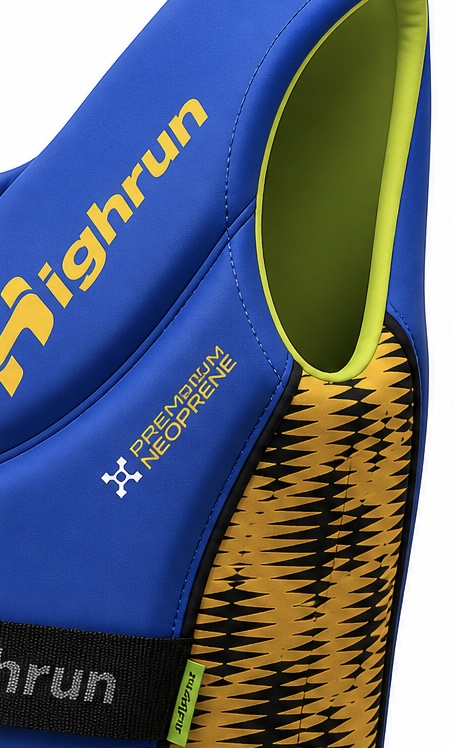
Minimum Order Quantities (MOQs) often trap inexperienced buyers. High aggregate minimums tie up your cash flow unnecessarily. Some manufacturers appear cheap initially but charge exorbitant hidden tooling fees when you request different sizes later.
You need to evaluate scalability upfront. Demand a strict breakdown of the MOQ per color and per size. A factory might quote a 500-piece MOQ. You must clarify if that means 500 total units, or 500 units for every single size and color variation.
Life jackets require specialized interior foam blocks (EPE or PVC foam). Grading a complete life jacket size run (from Infant and Youth up to Adult XXXL) requires distinct foam molds for every single size. Infant jackets, for example, require special head-support collars. Ask exactly how they handle tooling and mold costs for these distinct foam blocks.
Typical MOQ and Tooling Cost Expectations by Category
Size Category | Typical MOQ (Per Color) | Tooling Fee Impact | Manufacturing Complexity |
|---|---|---|---|
Infant / Toddler (Under 30 lbs) | 300 - 500 units | High (Requires head support molds) | Very High (Strict safety constraints) |
Youth (30 - 90 lbs) | 300 - 500 units | Medium (Standard block scaling) | Medium |
Adult Standard (XS - L) | 200 - 300 units | Low (Molds usually shared/standard) | Low |
Adult Oversize (XL - XXXL) | 100 - 200 units | Medium (Requires extra buoyancy foam) | Medium |
Use this evidence-oriented probe: "If our product goes viral this summer, what is your maximum monthly capacity? How much lead time do you need to scale up production?" A mature partner will know their exact monthly unit limit and provide a realistic timeline for adding secondary production lines.
Quality assurance means life or death in the water sports industry. Sub-standard buoyancy foam can lose its floatation properties over time. Weak stitching on buckles or zippers will snap during a high-speed water impact. You cannot afford these failures.
Ask the factory for a detailed virtual walkthrough of their production line. Have them reference the actual crafting process step-by-step. A trustworthy life jacket supplier will gladly show you their fabric cutting stations, foam insertion areas, and final inspection tables.
You must establish specific Quality Assurance (QA) checkpoints. Here are the most critical QA protocols to verify:
Raw Material Inspection: Do they check foam density upon arrival before cutting it?
Stitch Tension Testing: Do they use dynamometers to test the tensile strength of the harness straps?
Buoyancy Verification: Do they perform 100% tank testing for buoyancy, or do they rely on AQL (Acceptable Quality Limit) batch testing? (For USCG approval, individual batch testing in water tanks is mandatory).
Hardware Stress Tests: Do they freeze and bake buckles to ensure they do not become brittle in extreme weather?
Sourcing transparency represents another vital pillar of trust. Ask them to specify the exact origins of their high-load components. They should willingly name their suppliers for critical parts. For example, specify that you require YKK marine-grade zippers and ITW Nexus acetal buckles. If the factory refuses to disclose their sub-suppliers, they likely use cheap, generic hardware that will corrode in saltwater.
Supply chain bottlenecks can easily disrupt your seasonal retail launch. Missing the summer boating season leaves you sitting on expensive inventory for an entire year. Similarly, receiving a container full of unsellable defective units will cripple your cash flow.
Ask the manufacturer for standard lead times, broken down explicitly by phase. A typical timeline should look like this: CAD approval (7-10 days) -> First prototype delivery (14-21 days) -> Tooling and mold creation (30 days) -> Bulk production (45-60 days) -> Shipping and customs (30 days). Knowing these phases helps you spot unrealistic promises. If a factory claims they can go from CAD to delivery in 30 days, they are lying.
Address the financial terms clearly. Standard payment terms usually follow a 30/70 T/T structure. You pay a 30% deposit to initiate raw material purchasing. You pay the remaining 70% only after the goods pass a third-party inspection prior to shipment. Never pay 100% upfront.
Discuss defect resolution proactively. What recourse does the factory provide if the final defect rate exceeds your agreed AQL standard (e.g., AQL 2.5)? Will they rework the items at their expense, or offer a credit on the next order? Clarify this in writing.
Use this evidence-oriented probe: "Tell me about a time a production run failed quality control on the floor. How did you handle the situation with the buyer?" Listen closely to their answer. A good manufacturer takes accountability and explains their corrective action process. A bad manufacturer will claim they never make mistakes.
Finding the right manufacturing partner requires diligence, technical knowledge, and a healthy dose of skepticism. You must score potential partners based on a weighted matrix. Evaluate them heavily on verifiable compliance (Safety and Legal standards). Assess their prototyping accuracy (Product quality). Finally, judge their transparent communication (Partnership viability).
Your next step requires immediate action. Draft a comprehensive Non-Disclosure Agreement (NDA). Send a simplified "test" tech pack to your top three shortlisted manufacturers. Evaluate their response time, their technical comprehension of the design, and the clarity of their initial questions. This small test will reveal their true communication skills before you risk a single dollar on bulk production.
A: Prototyping costs typically range from $150 to $500 per style. This covers pattern making, material sourcing, and labor. If your design requires custom foam molding rather than standard foam blocks, expect tooling fees between $1,000 and $3,000. Fortunately, most reputable factories refund the basic prototype cost once you place a bulk order that meets their minimum requirements.
A: A realistic B2B baseline MOQ usually falls between 300 and 500 pieces per style and color. This number depends heavily on raw material availability. If you choose stock fabric colors, the factory might accept a lower MOQ. If you require custom-dyed fabrics to match your specific brand Pantone, the fabric mill will force the factory to increase your MOQ.
A: USCG approval is ultimately the brand's responsibility, not the factory's. However, the factory must produce flawless test samples for you to submit to a recognized lab like UL. This strict testing timeline typically takes 3 to 6 months. It absolutely requires a factory already deeply familiar with USCG compliance frameworks and construction manuals.


