
- All
- Product Name
- Product Keyword
- Product Model
- Product Summary
- Product Description
- Multi Field Search
Views: 0 Author: Site Editor Publish Time: 2026-09-09 Origin: Site


Water safety carries incredibly high stakes for families and aquatic centers alike. Selecting the wrong buoyancy aid can severely hinder a child's developing swimming posture. In dynamic environments like busy wave pools, a poor equipment choice might even compromise baseline safety. Unfortunately, the modern retail market overflows with uncertified products. This overwhelming saturation makes it difficult to choose correctly. Parents, swim instructors, and facility managers struggle to distinguish genuine swimming aids from basic, unreliable pool toys. You need trustworthy metrics to navigate these choices confidently. This comprehensive guide provides a clear, evidence-based framework. You will learn how to accurately evaluate a float vest for swim training based on buoyancy materials, design geometry, and strict facility compliance. Let us explore the critical details.
Purpose dictates design: A swimming aid float vest prioritizes arm mobility and horizontal body positioning, unlike traditional survival life jackets that force a vertical posture.
Material matters: Solid-core options (like an EPE foam buoyancy aid) eliminate the puncture risks associated with inflatables.
Fit is a safety feature: Crotch straps and heavy-duty zippers are non-negotiable to prevent the vest from riding up over a child’s head.
Compliance is mandatory: A true water park swim vest must meet specific safety standards (e.g., USCG or CE) to be permitted in commercial wave pools and slides.
Aquatic safety devices fall into distinct categories. You must understand their structural differences before purchasing. Misunderstanding these categories leads to poor training outcomes and safety risks.
Manufacturers build traditional Personal Flotation Devices (PFDs) for survival and rescue scenarios. Designers engineer them specifically to turn an unconscious person face-up in the water. They feature bulky foam blocks on the front chest and behind the neck. This design is excellent for open-water boating. However, it creates a major drawback for swim training. These jackets are highly restrictive. They force the wearer into a strict vertical positioning. This vertical stance severely delays learning proper horizontal swim strokes.
Inflatable arm bands remain cheap and widely available at most retail stores. Many parents buy them out of convenience. Despite their popularity, they carry significant drawbacks. Inflatables are highly prone to deflation from tiny punctures. They easily slip off wet arms during active play. Most importantly, they teach unsafe water dependency. Children develop a dangerous false sense of security. They learn to float vertically without engaging their core muscles.
Engineers design this specific garment for the active evaluation and learning stage. It balances core buoyancy with excellent shoulder mobility. The foam distribution allows children to practice forward strokes naturally. They maintain a proper, horizontal swimming posture. A quality swimming aid float vest supports the torso while leaving the arms completely free. This mechanical freedom is vital for developing independent swimming skills.
Device Type | Primary Purpose | Posture Promoted | Safety Reliability |
|---|---|---|---|
Traditional PFD | Survival / Rescue | Vertical / Face-up | Extremely High |
Inflatable Arm Bands | Recreational Play | Vertical (Dependent) | Low (Puncture Risk) |
Swimming Aid Vest | Skill Development | Horizontal (Active) | High (When Certified) |
Evaluating a training vest requires examining its internal materials and external geometry. Visual appeal means nothing if the underlying mechanics fail. You must inspect three primary criteria.
Internal buoyancy materials dictate the lifespan and safety of the vest. We strongly advise evaluating why an EPE foam buoyancy aid is the accepted industry standard. Expanded Polyethylene (EPE) provides consistent, puncture-proof flotation. It consists of closed-cell foam that physically cannot deflate. Inflatables suffer from thermal expansion and contraction. Outdoor heat causes cheap vinyl to stretch and warp. EPE foam remains entirely stable regardless of temperature changes. It delivers reliable buoyancy every single time a child enters the water.
A secure fit prevents dangerous accidents. Many parents mistakenly believe a snug chest zipper provides enough security. Water naturally pushes all buoyancy materials forcefully upward. A high-quality children swim vest must feature a dedicated anchoring system. It requires an adjustable, padded neoprene crotch strap. This strap runs between the legs and anchors the vest securely to the torso.
You should perform this simple test before entering the water:
Fasten the vest completely, including all zippers and buckles.
Tighten the crotch strap until it sits flush against the body.
Lift the child gently by the shoulders of the vest.
Observe the neckline. If the vest touches the child's chin or ears, it fails the test.
You must look for deep-cut armholes. A training vest should never impede shoulder rotation. Children need a full range of motion for freestyle and breaststroke techniques. If thick foam chafes their sensitive armpits, they will refuse to wear it. Poorly designed armholes also mechanically restrict proper swim stroke rotation. The child will fight the vest instead of focusing on their technique.
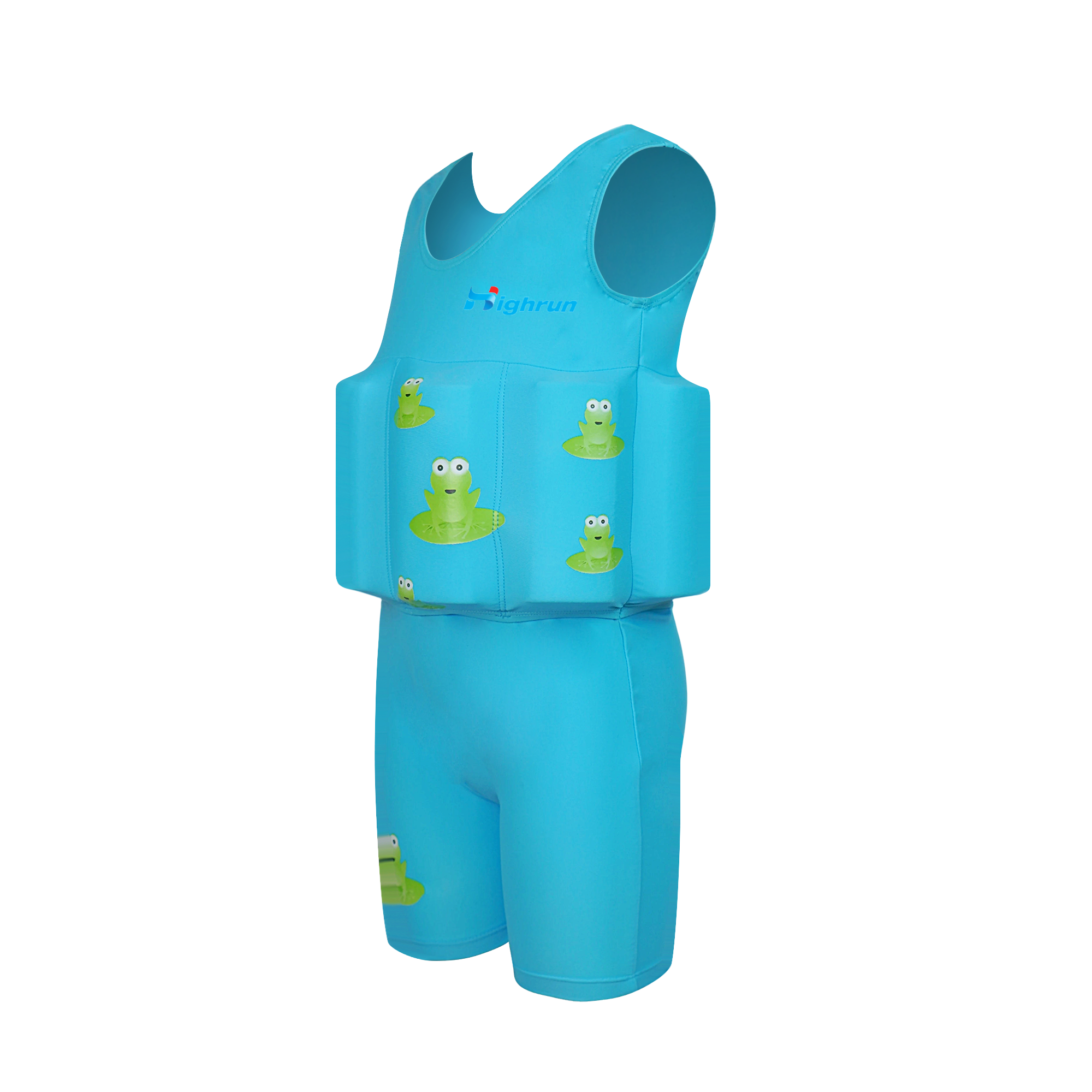
Public aquatic facilities enforce strict safety protocols. You cannot bypass these rules with unverified equipment. Understanding these regulations prevents frustrating rejections at the park entrance.
Many modern water parks strictly prohibit personal inflatables. They also ban non-certified foam vests. High-liability risks force facility managers to enforce rigid safety standards. Dynamic environments contain unpredictable elements. Wave pools generate artificial currents. Water slides create sudden impacts. A cheap retail pool toy simply cannot withstand these forces. Lifeguards will ask you to remove uncertified gear immediately.
You must know what to look for on the interior product label. A compliant water park swim vest typically displays specific regulatory approvals. In the United States, look for USCG Type III or Type V approval. This certifies the vest as a legitimate flotation aid. In European markets, look for the CE EN 13138-1 standard for swim aids. These credentials prove the manufacturer subjected the vest to rigorous laboratory stress tests.
Water park environments destroy weak materials quickly. Commercial chemicals, harsh chlorine, and constant UV exposure degrade untreated fabrics. Active environments demand tough construction. Manufacturers must utilize fade-resistant UV fabrics. They must incorporate reinforced double-stitching along every seam. Corrosion-resistant, heavy-duty zippers are absolutely essential. A broken zipper in a wave pool creates an immediate drowning hazard.
Proper sizing determines whether a vest functions correctly. Guessing a child's size based on arbitrary metrics often leads to dangerous outcomes. You must rely on physical measurements.
Relying on manufacturer age ranges is inherently flawed. You might see a label advertising "Ages 2-4." This label offers no real safety guarantee. A two-year-old and a four-year-old have vastly different body compositions. Buoyancy dynamics are strictly mathematical. They rely entirely on the volume of water displaced by the wearer's physical weight. You must base your purchase solely on the child's weight in kilograms or pounds. Check the specific weight limits printed on the interior warning label.
Accurate chest measurements prevent critical zipper failures. You must properly measure a child's chest circumference. Use a soft tailor's tape measure. Always measure over a standard swimsuit. Do not measure over bulky street clothes or heavy sweaters. The tape should sit snugly across the widest part of the chest. Accurate measurements ensure the zipper closes securely. The vest must fit tightly around the ribcage without constricting normal breathing.
Parents frequently try to save money by sizing up. We strongly warn against buying a larger size for a child to "grow into." This habit constitutes a severe safety hazard. A loose kids float vest radically alters the wearer's center of gravity. Excess interior space allows the buoyancy foam to shift upward. This shifting action pushes the child's face forward, risking immersion. The vest must fit perfectly today, not next year.
This section bridges the gap for swim schools, commercial water parks, and bulk B2B buyers. Sourcing equipment at scale requires analyzing supply chain reliability and strict quality assurance protocols.
Commercial buyers carry immense liability. A reputable float vest manufacturer must provide transparent documentation upon request. They should share comprehensive foam density testing results. They must also verify seam strength under mechanical tension. Consistent batch testing is crucial. If one vest fails in a commercial setting, the entire batch becomes suspect. Strict QC protocols guarantee absolute consistency across hundreds of units.
Commercial aquatic facilities often require highly tailored solutions. Standard retail designs rarely meet operational needs. Sourcing an OEM swim vest allows for strategic custom color-coding. You can assign bright neon colors based on specific size or weight classes. This system enables rapid visual identification for busy lifeguards. You can also print prominent facility logos directly onto the fabric. This deters theft and maintains brand professionalism.
Commercial vests undergo prolonged, daily use across multiple wearers. You must carefully assess the supplier's material choices. Look for skin-friendly, hypoallergenic outer layers. Premium Neoprene and high-denier Polyester are excellent choices. They encase the internal EPE foam securely. These soft materials prevent painful skin chafing during extended commercial use. Cheap nylon often causes severe rashes, leading to customer complaints.
The right vest always balances mandatory safety certifications with physical wearer comfort. This is the final decision logic you must apply. If the vest isn't comfortable, the child will simply refuse to wear it. If it isn't officially certified, the aquatic facility will not allow it inside the gates. You must satisfy both requirements simultaneously to ensure a positive training experience.
Take immediate action to secure the right equipment. Weigh your child carefully today using an accurate scale. If you manage a commercial facility, audit your current size requirements and inventory immediately. Always check the specific safety regulations of your local water park before finalizing any purchase. Preparation prevents accidents and guarantees a safer swimming environment for everyone.
A: No. They are designed to aid buoyancy and swimming posture, not to replace adult supervision or act as a survival life-saving device.
A: The vest is either too large, or it lacks (or isn't utilizing) a properly tightened crotch strap.
A: Generally, no. Machine washing can degrade the foam's integrity. Rinse thoroughly with fresh water after chlorine or saltwater exposure and hang dry in the shade.
A: Once they demonstrate unassisted treading, can confidently recover to a standing/floating position, and can swim short distances independently. Prolonged use beyond this can hinder independent water confidence.


